Your surgeon will call the VNS surgery: “out patient surgery”. In this case, what out-patient means is that your hospital will be your own bed at your own house and that your nurse will be a family member or friend who is willing to take care of you for a couple of days.
My surgeon offered local anesthesia or general anesthesia for the surgery. General has more risk as they put your body completely to sleep. I opted for this method as I really did not want to be awake as they were cutting into my chest & neck.
You will probably get some sheet with a list of instructions on what to do and not to do with regards to your surgery, here are a few tips they may have left out or did not emphasize enough:
Driving Home
You won’t be able to drive home after surgery… in fact, if you got the general anesthesia, you will be lucky to get in the vehicle without help, so make sure you have someone to cart you back to your domicile and feed you some well earned pain medications.
Phenegran
Remember that Phenegran that I recommended getting? Take that when you get home along with some of that “sick food” crackers & sprite. The general anesthesia and any other meds you took may cause you to get nauseaus… best to stop it before it starts.
Pain Meds
Hopefully you got your pain meds the day before like I suggested, because you are going to need them. Take them as prescribed and you will probably end up sleeping most of the day… and through the night.
Seizure Meds
Still got to take those too. So make sure that someone is around to keep track of all the pills you will be taking.
Rest
Don’t plan on doing anything but laying in bed the day of your surgery. Pile those pillows up and try not to move your neck too much.
Wednesday, January 24, 2007


Monday, January 22, 2007
Survivors Guide to VNS: Part 5 – Pre-Surgery Shopping
Before you have your surgery, there are a number of items you should purchase to make your post-surgery life a bit easier.
Pain medications
Have your doctor give you prescriptions for your pain meds. Pick them up the day before surgery so that you wont have to go out to get them or pick them up on the way back home from surgery.
Phenegran
General anesthesia tends to make people nauseous. It definitely did me. From first hand experience, throwing up everything in your system is not fun after just having surgery. Get the phenegran before you have surgery.
Lozenges
If you have a breathing tube in your throat while under general anethesia, your throat is going to hurt. Go ahead and get your throat lozenges. Any menthol based lozenge will help, but my favorite is Ricola!
Pillows
For a few weeks, you are going to be sleeping in strange positions in order to avoid pressing on your fresh wounds. Many people on the VNS Message Board recommend those beanie pillows. I ended up just mixing and matching pillows from around the house. In any case, make sure you have a bunch, and of different sizes.
Sick Food
Get a bunch of that food you eat when you have a cold. Crackers, chicken noodle soup, Sprite, yada yada… You really won’t feel like steak and potatoes for a few days.
Pain medications
Have your doctor give you prescriptions for your pain meds. Pick them up the day before surgery so that you wont have to go out to get them or pick them up on the way back home from surgery.
Phenegran
General anesthesia tends to make people nauseous. It definitely did me. From first hand experience, throwing up everything in your system is not fun after just having surgery. Get the phenegran before you have surgery.
Lozenges
If you have a breathing tube in your throat while under general anethesia, your throat is going to hurt. Go ahead and get your throat lozenges. Any menthol based lozenge will help, but my favorite is Ricola!
Pillows
For a few weeks, you are going to be sleeping in strange positions in order to avoid pressing on your fresh wounds. Many people on the VNS Message Board recommend those beanie pillows. I ended up just mixing and matching pillows from around the house. In any case, make sure you have a bunch, and of different sizes.
Sick Food
Get a bunch of that food you eat when you have a cold. Crackers, chicken noodle soup, Sprite, yada yada… You really won’t feel like steak and potatoes for a few days.
Survivors Guide to VNS: Part 4 – Can my cat hear it?
I was surfing through the VNS Message Board when I found this controversial question:
Will my cat be able to hear when my VNS activates?
One lady claimed that her cat appeared to notice when her VNS activated. My response was that there was no way that could happen and that she and her cat were just imagining things. However, on further reflection, although the human ear does not pick up on any sound from the device, it might be possible that when the Vagus nerve stimulates the voice box, that the vocal cords emit sound that is inaudible to the human ear, but is able to be heard by a cat. So I suppose it is plausible that her cat could indeed hear when the VNS activated. In my personal experience, neither my dog or cat have seemed to notice anything when the VNS activates.
Can I still use a post hole digger?
Yes… after a while. Here is the deal, the implant isn’t stapled to your chest or clamped onto any bones, so it can move under the skin. Although it is mostly round, it does have a flat side with wires coming out of it. So when you make movements that cause your muscles or skin to rub against the device, it can be uncomfortable. For about 6 months, it was very irritating to my chest if I did anything that required repetitive movements that caused the VNS to move. But just last weekend, I dug a few holes with a post hole digger and did not have any problems. My recommendation: wait a few months before using your post hole digger.
Where can I go to get more answers about the VNS that aren’t contained in the Patients Manual or Physicians Manual?
First, make sure you read both of those manuals before you decide to have surgery. They are the official instructions from Cyberonics.
Second, ask your neurologist or surgeon. Odds are that neither of these has a VNS themselves, and won’t be able to answer very personal questions, but they are usually familiar with what their patients report.
Third, if you want information from people who actually have the VNS, post a message at the VNS Message Board.
Will my cat be able to hear when my VNS activates?
One lady claimed that her cat appeared to notice when her VNS activated. My response was that there was no way that could happen and that she and her cat were just imagining things. However, on further reflection, although the human ear does not pick up on any sound from the device, it might be possible that when the Vagus nerve stimulates the voice box, that the vocal cords emit sound that is inaudible to the human ear, but is able to be heard by a cat. So I suppose it is plausible that her cat could indeed hear when the VNS activated. In my personal experience, neither my dog or cat have seemed to notice anything when the VNS activates.
Can I still use a post hole digger?
Yes… after a while. Here is the deal, the implant isn’t stapled to your chest or clamped onto any bones, so it can move under the skin. Although it is mostly round, it does have a flat side with wires coming out of it. So when you make movements that cause your muscles or skin to rub against the device, it can be uncomfortable. For about 6 months, it was very irritating to my chest if I did anything that required repetitive movements that caused the VNS to move. But just last weekend, I dug a few holes with a post hole digger and did not have any problems. My recommendation: wait a few months before using your post hole digger.
Where can I go to get more answers about the VNS that aren’t contained in the Patients Manual or Physicians Manual?
First, make sure you read both of those manuals before you decide to have surgery. They are the official instructions from Cyberonics.
Second, ask your neurologist or surgeon. Odds are that neither of these has a VNS themselves, and won’t be able to answer very personal questions, but they are usually familiar with what their patients report.
Third, if you want information from people who actually have the VNS, post a message at the VNS Message Board.
Thursday, January 11, 2007
Survivors Guide to VNS: Part 3 – Does it work?
This is probably the most asked question about VNS that I get.
Will the VNS cure my seizures?
I think that most people simply want a Yes or No answer as to whether it completely stopped you from having seizures. Unfortunately it is not that simple. The VNS will not cure you of epilepsy, but it can help control seizures or reduce the intensity and after-effects. The level of effectiveness varies between persons.
The studies by Cyberoics indicate that most people take anywhere from 3 months to a year before they get meaningful results from the device. In addition, many people report increasing effectiveness the longer they have the VNS.
Given all that, rephrasing the question would be the best way to get a meaningful answer. Instead of "Does it work?" ask, "What type of results are you getting from your VNS so far?"
Answer:
So far, the VNS has drastically reduced the intensity and severity of my seizures. I have had mine a year now and it has also reduced the number of seizures I have. I have high hopes that the device will bring additional improvement over time.
Will the VNS cure my seizures?
I think that most people simply want a Yes or No answer as to whether it completely stopped you from having seizures. Unfortunately it is not that simple. The VNS will not cure you of epilepsy, but it can help control seizures or reduce the intensity and after-effects. The level of effectiveness varies between persons.
The studies by Cyberoics indicate that most people take anywhere from 3 months to a year before they get meaningful results from the device. In addition, many people report increasing effectiveness the longer they have the VNS.
Given all that, rephrasing the question would be the best way to get a meaningful answer. Instead of "Does it work?" ask, "What type of results are you getting from your VNS so far?"
Answer:
So far, the VNS has drastically reduced the intensity and severity of my seizures. I have had mine a year now and it has also reduced the number of seizures I have. I have high hopes that the device will bring additional improvement over time.
Wednesday, January 10, 2007
Survivor's Guide to VNS: Part 2 - Activities
More questions about VNS.
Will I still be able to play football?
Not so much. Although the pulse generator is encased in titanium and has about a zero chance of breaking open from a hit by a linebacker, the delicate leads are not so invulnerable. The leads are carefully wrapped around your vagus nerve and can come loose or break if you got hit in the neck by a ball or arm or leg or whatever. Use some common sense here and avoid activities that may involve objects colliding with your neck.
Can I swim with my VNS?
Sure can! That thing is completely inside your body and fluid-proof to boot! Granted, if your seizures are not completely controlled, you probably don’t want to be out there doing laps by yourself...
Can I still ride roller-coasters?
I rode the Top Gun roller-coaster at Carowinds about 6 months after my VNS surgery. I made it through ok, but the harness rubbed against my pulse generator and I was nervous about my head being jerked around. I survived just fine and my VNS system did not encounter any problems… but I don’t plan to ride any other coasters. Unfortunately, that was my last time I will get to experience 5 gravities while going 55 miles per hour through an inverted loop. Final answer: Not so much.
How about plane flights? Can I do those?
Yep! I have taken several flights since I have had my VNS. I haven’t had any negative effects from it.
Will the metal detectors go off at the airport screening?
Nope! The case is made of titanium and the battery is lithium. Neither will set off the alarms.
How about the magnet? Will the airport people give me problems?
I have carried my magnets with me on the plane. No questions about them at all.
Will I still be able to play football?
Not so much. Although the pulse generator is encased in titanium and has about a zero chance of breaking open from a hit by a linebacker, the delicate leads are not so invulnerable. The leads are carefully wrapped around your vagus nerve and can come loose or break if you got hit in the neck by a ball or arm or leg or whatever. Use some common sense here and avoid activities that may involve objects colliding with your neck.
Can I swim with my VNS?
Sure can! That thing is completely inside your body and fluid-proof to boot! Granted, if your seizures are not completely controlled, you probably don’t want to be out there doing laps by yourself...
Can I still ride roller-coasters?
I rode the Top Gun roller-coaster at Carowinds about 6 months after my VNS surgery. I made it through ok, but the harness rubbed against my pulse generator and I was nervous about my head being jerked around. I survived just fine and my VNS system did not encounter any problems… but I don’t plan to ride any other coasters. Unfortunately, that was my last time I will get to experience 5 gravities while going 55 miles per hour through an inverted loop. Final answer: Not so much.
How about plane flights? Can I do those?
Yep! I have taken several flights since I have had my VNS. I haven’t had any negative effects from it.
Will the metal detectors go off at the airport screening?
Nope! The case is made of titanium and the battery is lithium. Neither will set off the alarms.
How about the magnet? Will the airport people give me problems?
I have carried my magnets with me on the plane. No questions about them at all.
Tuesday, January 09, 2007
Survivors Guide to VNS: Part 1 – To Cut or Not to Cut
Here are some questions I had for my surgeon, neurologist, and Cyberonics that I didn’t feel were answered adequately. I don’t think that it was due to ignorance or deception, but only that none of them had actually had the surgery themselves.
Does the surgery hurt?
Yep! It feels about like what you would expect from someone slicing open your neck and chest and then inserting foreign objects. Luckily, some clever people have developed some very effective pain killers that will help you until the wounds heal.
Will anyone notice the scars?
They sure will until they heal! The wounds will look like any other cut. For many weeks, the cuts will be red and swollen. For the first week or so, it will look quite bad. But what can you expect from getting significant incisions in your body?
Will the scars eventually go away?
They never “go away”, but they do get less noticeable over time. From my experience, the young people I have seen have the least noticeable scars. Unless you know exactly where to look and suspect that they may have a VNS, you won’t see it on their neck.
Will I be able to sing?
Not so much. The side effects of the device are such that when it activates, you will not be able to sing pleasantly during that time. Don’t plan on doing any long solos. And if singing is your greatest pleasure in life… you may want to reconsider having the surgery.
Will I be able to talk well?
Yes. Although it may take some time to get the settings to a point where you can talk easily during the time when your VNS is sending a pulse. A year after my surgery, and I still have difficulties talking for long periods of time or during the time when my device is sending a pulse.
Can people see the VNS wire/lead?
Yes… barely. In fact, so faintly that I had to argue with my father several times before he finally believed that the wire was not just another vein or ligament normally found on a neck. For the most part, unless you lean your head far to the right and then point at the lead, no one notices.
Does the surgery hurt?
Yep! It feels about like what you would expect from someone slicing open your neck and chest and then inserting foreign objects. Luckily, some clever people have developed some very effective pain killers that will help you until the wounds heal.
Will anyone notice the scars?
They sure will until they heal! The wounds will look like any other cut. For many weeks, the cuts will be red and swollen. For the first week or so, it will look quite bad. But what can you expect from getting significant incisions in your body?
Will the scars eventually go away?
They never “go away”, but they do get less noticeable over time. From my experience, the young people I have seen have the least noticeable scars. Unless you know exactly where to look and suspect that they may have a VNS, you won’t see it on their neck.
Will I be able to sing?
Not so much. The side effects of the device are such that when it activates, you will not be able to sing pleasantly during that time. Don’t plan on doing any long solos. And if singing is your greatest pleasure in life… you may want to reconsider having the surgery.
Will I be able to talk well?
Yes. Although it may take some time to get the settings to a point where you can talk easily during the time when your VNS is sending a pulse. A year after my surgery, and I still have difficulties talking for long periods of time or during the time when my device is sending a pulse.
Can people see the VNS wire/lead?
Yes… barely. In fact, so faintly that I had to argue with my father several times before he finally believed that the wire was not just another vein or ligament normally found on a neck. For the most part, unless you lean your head far to the right and then point at the lead, no one notices.
Monday, January 08, 2007
Survivors Guide to VNS
On January 12th of last year I had my VNS surgery. Although I had done a significant amount of research on the device and the surgery, there were a number of things I learned during the experience. I’ll be posting them over the next few days.
Friday, January 05, 2007
Wes Autry and Invisible Epilepsy
I watched an interview by David Letterman with Wes Autry last night. Evidently, the subway rescue incident did not start with the young man falling, but with him having a seizure on the platform. Autry and two other ladies helped the young man, Hollowpeter, because he had a seizure. Excepting the pen that Autry said they stuck in his mouth, his description of the methods they used when caring for him were quite good. After the seizure eneded, Hollowpeter recovered some, but then had a second seizure which caused him to fall off the platform.
It is interesting that the news coverage really doesn't mention any details about epilepsy. Call me bitter, cynical, or just plain grumpy, but if it was any other disease or condition, CNN would have Dr. Sanjay Gupta on the tube telling us all about it... for days on end.
It is interesting that the news coverage really doesn't mention any details about epilepsy. Call me bitter, cynical, or just plain grumpy, but if it was any other disease or condition, CNN would have Dr. Sanjay Gupta on the tube telling us all about it... for days on end.
Wednesday, January 03, 2007
Subway Hero Saves Man Having Seizure.
Cameron Hollowpeter, 18, fell onto the tracks at the 137th Street and Broadway Station after apparently suffering a seizure, according to authorities.
Wes Autrey, a Navy veteran and construction worker, was standing nearby on the platform with his children when he saw Hollowpeter fall. Autrey jumped down to the track area and lay on top of Hollowpeter as a train passed about "2 inches" from his head.
In the split-second he had to decide as a southbound 1 train approached, Autrey said he chose to stay in the "gutter" between two sets of subway tracks instead of trying to pull the victim back up to the platform.
"I chose to dive on top of him and pin him down and myself down," said Autrey, 50.
Autrey said the rescue was especially difficult because Hollowpeter was confused and frightened.
"He didn't know who I was," said Autrey. "He was incoherent. The train comes and I have to make the decision whether to struggle and try to get him up to the platform or dive for the gutter and just push him back. So my thing was to just push him back and lay on top of him."
Wes Autrey, a Navy veteran and construction worker, was standing nearby on the platform with his children when he saw Hollowpeter fall. Autrey jumped down to the track area and lay on top of Hollowpeter as a train passed about "2 inches" from his head.
In the split-second he had to decide as a southbound 1 train approached, Autrey said he chose to stay in the "gutter" between two sets of subway tracks instead of trying to pull the victim back up to the platform.
"I chose to dive on top of him and pin him down and myself down," said Autrey, 50.
Autrey said the rescue was especially difficult because Hollowpeter was confused and frightened.
"He didn't know who I was," said Autrey. "He was incoherent. The train comes and I have to make the decision whether to struggle and try to get him up to the platform or dive for the gutter and just push him back. So my thing was to just push him back and lay on top of him."
Blogstuff - Blogspot II & Feedburner
I converted the blog to the new blogspot format. It wasn't hard, but it did require a good bit of cutting and pasting to get all the links correct. Today I added a Feedburner link down at the bottom. You can now easily add this feed to your RSS readers now. Here is the link:
Tuesday, January 02, 2007
Mistletoe a cure for epilepsy?

I am always on the lookout for a cure for my epilepsy... never did I imagine that it would be hanging right above my head. Evidently, some cultures believe that mistletoe can cure epilepsy... along with just about everything else. The passage below is from the A. Austin Amerine Spiritual Retreat Center website and represents only a small portion of the many uses for mistletoe.
From the Middle Ages to the last century, the literature is filled with examples of different uses for mistletoe plants, especially among rural people. It was cut, tied in bunches, and hung in front of cottages to scare away passing demons. It was hung over doors of stables to protect horses and cattle against witchcraft. In Sweden, it was kept in houses to prevent fire. Swedish farmers hung mistletoe in the horse's stall and the cow's crib, to protect against evil trolls. They also used the wood to make divining rods. In Italy it was believed to be able to extinguish fire. It was widely held to be a universal healer. As a potion it would make barren animals conceive. Even Pliny had known it was a cure for epilepsy, and that it could be used to promote conception. It healed ulcers if chewed. In Wales, mistletoe gathered on Midsummer Eve was placed under the pillow at Yuletide to induce prophetic dreams. Norwegian peasants hung mistletoe from the rafters of their homes to protect against lightning. There are various customs in several countries that utilized mistletoe plants in rituals to find treasure. Collectively, these customs prove that mistletoe had a profound effect on people's lives and imaginations since the remotest past of human history.
Monday, January 01, 2007
Monday, December 18, 2006
Epilepsy v. XBox

Over the years I have heard many stories of how caretakers can tell if their loved one is having or is about to have a seizure. Jack's story is the first of which I have heard where a lack of playing a video game has been cited. Now, through the combined power of Jacks experience, your post, and Google searches, you may make it possible for hundreds of children living with epilepsy to convince their parents to let them play more XBox games. Any time there is a pause in the sound of Covenant aliens (Halo) being destroyed, their moms should check on them!
It is really amazing that he is able to play. When I was younger, my refexes were so slowed from the Tegretol I was taking, that I was completely unable to play action games. It was not that I couldn't move the controls, but my reflexes were too slow. Like Jack, I now take Lamictal, and my reflexes are not impaired... in fact, so drastic is the difference that I often wonder if the medicine improves my dexterity.

This just hit me... If Jack can do well with one hand on an XBox control, I bet he could do wonders with the Wii controller - you only need one hand to use it!
Friday, December 15, 2006
From The Adventures of Jack
So, imagine you are three years old. You started walking at 10 months, you have a great vocabulary for your age and you are just a little clumsy, just like Daddy. In other words, you're a rather normal little boy, going to pre-school, learning to be self-aware and independent. Then, one night when you are 3 1/2, you wake and your arm is asleep. So, you get out of bed and go tell mommy and daddy who are still watching TV. But your arm isn't just tingly, it can't move. It's paralyzed. "That's OK," mommy and daddy say, "it's just really asleep. Let's go back to bed." A month later, no one really notices when you seem a little sleepier, or a little clumsier in the mornings. After all, you are only 3 1/2. Then, one morning, something happens and then you notice that mommy and daddy are asking if you are OK. They've just watched your right arm start shaking, while your eyes were open but blank. It lasted only about 30 seconds, and you don't remember a thing, but mommy and daddy look concerned and schedule a doctor's appointment. The doctor makes you jump up and down, move your arms in funny ways, do some high fives, touch your nose. He says you are probably OK, but if it happens again, mommy and daddy should call.
It happens again. Almost three years later, you are now in Kindergarten, and it's still happening.
Jack is my son, and he has a seizure disorder. Most people know it as Epilepsy. The doctors think it is a particularly kind of Epilepsy characterized by continuous or persistent abnormal electrical activity during "slow wave" sleep. ESES - Electrical Status Epilepticus Sleep. It's the same as, or slightly different than (Doctors disagree), CSWS - Continuous Spike Waves During Slow Wave Sleep. Jack may also have Landau Kleffner Syndrome. ESES/CSWS is a component of LKS. LKS is typically characterized by a loss of the ability to express or understand spoken language - or both. Some people with LKS, ESES, CSWS don't have visible seizures. Jack has had them all. And it is clear that his ability to express himself verbally has been effective, though not severely. The Doctor hopes that Jack's left-handedness is evidence that maybe his speech is controlled on his right brain.
Since May 2004, Jack has had each of the following kinds of seizures - appearing approximately in this order.
Complex Partial Seizures (with Todd's Paralysis)
Absence Seizures
Simple Partial Seizures
Simple Partial with secondary generalization
Myoclonic
Cluster absence seizures
Head droop seizures
Atonic Seizures (Drop Attacks)
Complex Partial again
Simple Partial again
Absence again
Droop again
Myoclonic
Tonic-Clonic (First ever full body seizure was this morning)
Since May 2004, Jack has been on the following medications. Usually, when the meds are changed, we see 4-8 weeks without seizures, then they return and we increase or change the medication and get another reprieve (except one mediciation that made things worse). Anyway, here goes.
Trileptal
Trileptal/Lamictal
Lamictal
Lamictal/Depakote
Lamictal/Depakote/Keppra
Lamictal/Depakote/Klonopin
(4 uses of diastat (valium) - 2 in last week).
So, there are the basics. How is a Kindergartener supposed to learn to write when his right hand is weak and almost useless and he left is unsteady and shaky?
Want to know how a 6 year old with no fine motor skills in his right hand (can't even hold a small object) plays XBox. He uses just his left hand, controlling one joystick with his palm and tapping the buttons at the same time.
Want to know how to tell if seizures are returning before you actually start seeing them? He loses interest in playing XBox.
Right now the Doctors don't know what to do. We have increased the Lamictal again and hope to see results so we can all have a fun and seizure-free Christmas. Otherwise, we'll return to the Epilepsy Unit at Wake Forest to be left, once again, with no clear idea of what to do.
Finally, I grew up knowing nothing about epilepsy, other than jokes about "get the spoon!" (bad idea, by the way). It's amazing that so many people are living with this, yet apparently, Epilepsy just doesn't have the high profile of much less common afflictions - mostly because Epilepsy takes so many forms and is often not debilitating. But sometimes, it is.
Now, imagine you are 6 years old. You're having breakfast when both arms start seizing and your whole body goes rigid. Mommy lays you down on the hardwood floor because, well, the kitchen has hard wood floors and a rigid 6 year old is hard to carry to the carpet or couch. Now imagine the big seizure ends but you start having a lot of little ones and mommy takes you to the couch. She calls daddy and puts him on speaker phone while mommy goes upstairs to get the diastat to give you a rectal dose of valium. And you know that's what's coming. Your shoulder starts twitching, eyes are dilating. And undilating. And dilating again. The seizures aren't stopping. And daddy asks you "Jack, how are you feeling?" You struggle to get the word from your brain to your mouth. Then you answer, as you always do, "Great!" Because you don't remember when seizures weren't a part of your life. And you are "Great!"
It happens again. Almost three years later, you are now in Kindergarten, and it's still happening.
Jack is my son, and he has a seizure disorder. Most people know it as Epilepsy. The doctors think it is a particularly kind of Epilepsy characterized by continuous or persistent abnormal electrical activity during "slow wave" sleep. ESES - Electrical Status Epilepticus Sleep. It's the same as, or slightly different than (Doctors disagree), CSWS - Continuous Spike Waves During Slow Wave Sleep. Jack may also have Landau Kleffner Syndrome. ESES/CSWS is a component of LKS. LKS is typically characterized by a loss of the ability to express or understand spoken language - or both. Some people with LKS, ESES, CSWS don't have visible seizures. Jack has had them all. And it is clear that his ability to express himself verbally has been effective, though not severely. The Doctor hopes that Jack's left-handedness is evidence that maybe his speech is controlled on his right brain.
Since May 2004, Jack has had each of the following kinds of seizures - appearing approximately in this order.
Complex Partial Seizures (with Todd's Paralysis)
Absence Seizures
Simple Partial Seizures
Simple Partial with secondary generalization
Myoclonic
Cluster absence seizures
Head droop seizures
Atonic Seizures (Drop Attacks)
Complex Partial again
Simple Partial again
Absence again
Droop again
Myoclonic
Tonic-Clonic (First ever full body seizure was this morning)
Since May 2004, Jack has been on the following medications. Usually, when the meds are changed, we see 4-8 weeks without seizures, then they return and we increase or change the medication and get another reprieve (except one mediciation that made things worse). Anyway, here goes.
Trileptal
Trileptal/Lamictal
Lamictal
Lamictal/Depakote
Lamictal/Depakote/Keppra
Lamictal/Depakote/Klonopin
(4 uses of diastat (valium) - 2 in last week).
So, there are the basics. How is a Kindergartener supposed to learn to write when his right hand is weak and almost useless and he left is unsteady and shaky?
Want to know how a 6 year old with no fine motor skills in his right hand (can't even hold a small object) plays XBox. He uses just his left hand, controlling one joystick with his palm and tapping the buttons at the same time.
Want to know how to tell if seizures are returning before you actually start seeing them? He loses interest in playing XBox.
Right now the Doctors don't know what to do. We have increased the Lamictal again and hope to see results so we can all have a fun and seizure-free Christmas. Otherwise, we'll return to the Epilepsy Unit at Wake Forest to be left, once again, with no clear idea of what to do.
Finally, I grew up knowing nothing about epilepsy, other than jokes about "get the spoon!" (bad idea, by the way). It's amazing that so many people are living with this, yet apparently, Epilepsy just doesn't have the high profile of much less common afflictions - mostly because Epilepsy takes so many forms and is often not debilitating. But sometimes, it is.
Now, imagine you are 6 years old. You're having breakfast when both arms start seizing and your whole body goes rigid. Mommy lays you down on the hardwood floor because, well, the kitchen has hard wood floors and a rigid 6 year old is hard to carry to the carpet or couch. Now imagine the big seizure ends but you start having a lot of little ones and mommy takes you to the couch. She calls daddy and puts him on speaker phone while mommy goes upstairs to get the diastat to give you a rectal dose of valium. And you know that's what's coming. Your shoulder starts twitching, eyes are dilating. And undilating. And dilating again. The seizures aren't stopping. And daddy asks you "Jack, how are you feeling?" You struggle to get the word from your brain to your mouth. Then you answer, as you always do, "Great!" Because you don't remember when seizures weren't a part of your life. And you are "Great!"
Monday, December 11, 2006
Guest Blogger!
I have invited a guest blogger, Winston, to share his first-hand experiences with a type of epilepsy called Electrical Status Epilepticus Sleep (ESES) and the Landau-Kleffner Syndrome. Winston is an avid blogger and will be doing a series of posts and updates about his son’s struggle with the condition.
Friday, December 08, 2006
NeuroPace
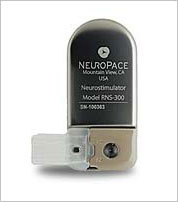
I did a little additional research on Neuropace and their Responsive Neurostimulator (RNS) The company is located in California and they have one product, the RNS, that is currently being tested in clinical trials. This is the product description from their site:
The Responsive Neurostimulator (RNS) system is designed for the treatment of medically refractory partial epilepsy. The RNS system includes implantable and external products, accessories and tools.
Implantable components include the responsive neurostimulator (RNS) as well as depth leads and cortical strip leads. The RNS is a programmable, battery powered, microprocessor-controlled device that delivers a short train of electrical pulses to the brain through implanted leads. In treating epilepsy, the RNS is designed to detect abnormal electrical activity in the brain and respond by delivering electrical stimulation to normalize brain activity before the patient experiences seizure symptoms. The RNS is implanted in the cranium and connected to one or two leads that are implanted near the patient's seizure focus.
Check out the brief description of the clinical trials that have been done. The device looks very promising.
A brief overview of the company can be found here.
Thursday, December 07, 2006
Wake Forest University Baptist Medical Center To Test New Epilepsy Treatment
This is a new research study on experimental epilepsy treatement being conducted from the Wake Forest Baptist Medical Center (in my home town!) It appears that you can still enroll in the study. There is contact information at the bottom.
Wake Forest University Baptist Medical Center To Test New Epilepsy Treatment
WINSTON-SALEM – Epilepsy specialists at Wake Forest University Baptist Medical Center are testing an investigational device designed to control seizures in patients with epilepsy. The device is a responsive neurostimulator (RNS™ System) which is implanted in the brain, detects abnormal electrical activity in the brain and sends out electrical impulses to prevent seizures. Wake Forest Baptist is the only center in North Carolina, Tennessee and South Carolina to test the device made by NeuroPace.
“This technology offers new hope to patients who have not responded to other treatments currently available and continue to have seizures,” said William Bell, M.D., an epileptologist and principal investigator for the study at the medical center.
Unlike the vagal nerve stimulator, another implantable device to treat seizures, the RNS treats the exact area of the brain affected by seizures. These are often areas of the brain that cannot be safely removed by epilepsy surgery. Patients are unaware of the electrical impulses used to control their seizures.
To enroll in the study, patients must be between the ages of 18 and 70 and have had an average of three seizures per month for the last three months, despite being treated with medication for partial epilepsy.
Over 240 people will be enrolled in the study at 28 medical centers nationwide for a two- to three-year period. Patients will be asked to keep a diary of their seizure activity and use a laptop and data transmitter to send information from their device to neurologists at Wake Forest Baptist to analyze.
The device is surgically implanted in a patient’s head by Steven Glazier, M.D. a neurosurgeon at the medical center, and can be turned on and off by the patient’s neurologist. For the first four months, 50 percent of patients will have the device turned on and 50 percent will have their device off. Researchers will track each participant’s progress during this phase. For the last 18 months of the study, all patients will have their device turned on and will record their health status on a routine basis. Patients will continue to receive their current epilepsy treatment while participating in the study.
“In order to determine if the device is effective, we have to turn off the devices in one group to compare with the group with the devices that are turned on,” Bell said. “After a four-month window, then we will turn all the devices on and see what the benefit to the patient is.”
“We hope this will be a new option for patients with epilepsy who continue to have seizures,” Bell said.
Other colleagues participating in the study include: Neurologists Cormac O’Donovan, M.D., Maria Sam, M.D., and Mary Campagna-Gibson, M.D. Jo Shuping is the research coordinator for the study.
For more information about the study, call Jo Shuping at 336-716-8694.
Wake Forest University Baptist Medical Center To Test New Epilepsy Treatment
WINSTON-SALEM – Epilepsy specialists at Wake Forest University Baptist Medical Center are testing an investigational device designed to control seizures in patients with epilepsy. The device is a responsive neurostimulator (RNS™ System) which is implanted in the brain, detects abnormal electrical activity in the brain and sends out electrical impulses to prevent seizures. Wake Forest Baptist is the only center in North Carolina, Tennessee and South Carolina to test the device made by NeuroPace.
“This technology offers new hope to patients who have not responded to other treatments currently available and continue to have seizures,” said William Bell, M.D., an epileptologist and principal investigator for the study at the medical center.
Unlike the vagal nerve stimulator, another implantable device to treat seizures, the RNS treats the exact area of the brain affected by seizures. These are often areas of the brain that cannot be safely removed by epilepsy surgery. Patients are unaware of the electrical impulses used to control their seizures.
To enroll in the study, patients must be between the ages of 18 and 70 and have had an average of three seizures per month for the last three months, despite being treated with medication for partial epilepsy.
Over 240 people will be enrolled in the study at 28 medical centers nationwide for a two- to three-year period. Patients will be asked to keep a diary of their seizure activity and use a laptop and data transmitter to send information from their device to neurologists at Wake Forest Baptist to analyze.
The device is surgically implanted in a patient’s head by Steven Glazier, M.D. a neurosurgeon at the medical center, and can be turned on and off by the patient’s neurologist. For the first four months, 50 percent of patients will have the device turned on and 50 percent will have their device off. Researchers will track each participant’s progress during this phase. For the last 18 months of the study, all patients will have their device turned on and will record their health status on a routine basis. Patients will continue to receive their current epilepsy treatment while participating in the study.
“In order to determine if the device is effective, we have to turn off the devices in one group to compare with the group with the devices that are turned on,” Bell said. “After a four-month window, then we will turn all the devices on and see what the benefit to the patient is.”
“We hope this will be a new option for patients with epilepsy who continue to have seizures,” Bell said.
Other colleagues participating in the study include: Neurologists Cormac O’Donovan, M.D., Maria Sam, M.D., and Mary Campagna-Gibson, M.D. Jo Shuping is the research coordinator for the study.
For more information about the study, call Jo Shuping at 336-716-8694.
Monday, December 04, 2006
Subscribe!
Sunday, December 03, 2006
Off Topic: A Knock on the Duir
I rarely post anything like this little gem. But the artwork was pretty cool and the poetry inspiring. Check out: A Knock on the Duir
I found it in a post at the VNS Message Board.
I found it in a post at the VNS Message Board.
Saturday, December 02, 2006
Sharing Our Days
Sharing Our Days is a blog dedicated to helping people with ongoing health conditions, including epilepsy. There is a small community and a collection of blogs for many different contitions. Check it out.
Subscribe to:
Posts (Atom)